INDUSTRY
REMITTANCE FINTECH
CLIENT
WorldRemit (In-house)
YEAR
2023
EXPERIENCE
CONTENT DESIGN

WorldRemit: Discovery screens
about.
WorldRemit helps 14M customers every year to send and receive money in over 90 countries worldwide with a choice of over 70 currencies. The classic WorldRemit app's onboarding process became tedious and archaic with the emergence of several similar products in the last decade in their strongest markets.
To differentiate ourselves from competitors, we employed our unique tone of voice and provided additional onboarding context to streamline the user journey.
challenge.
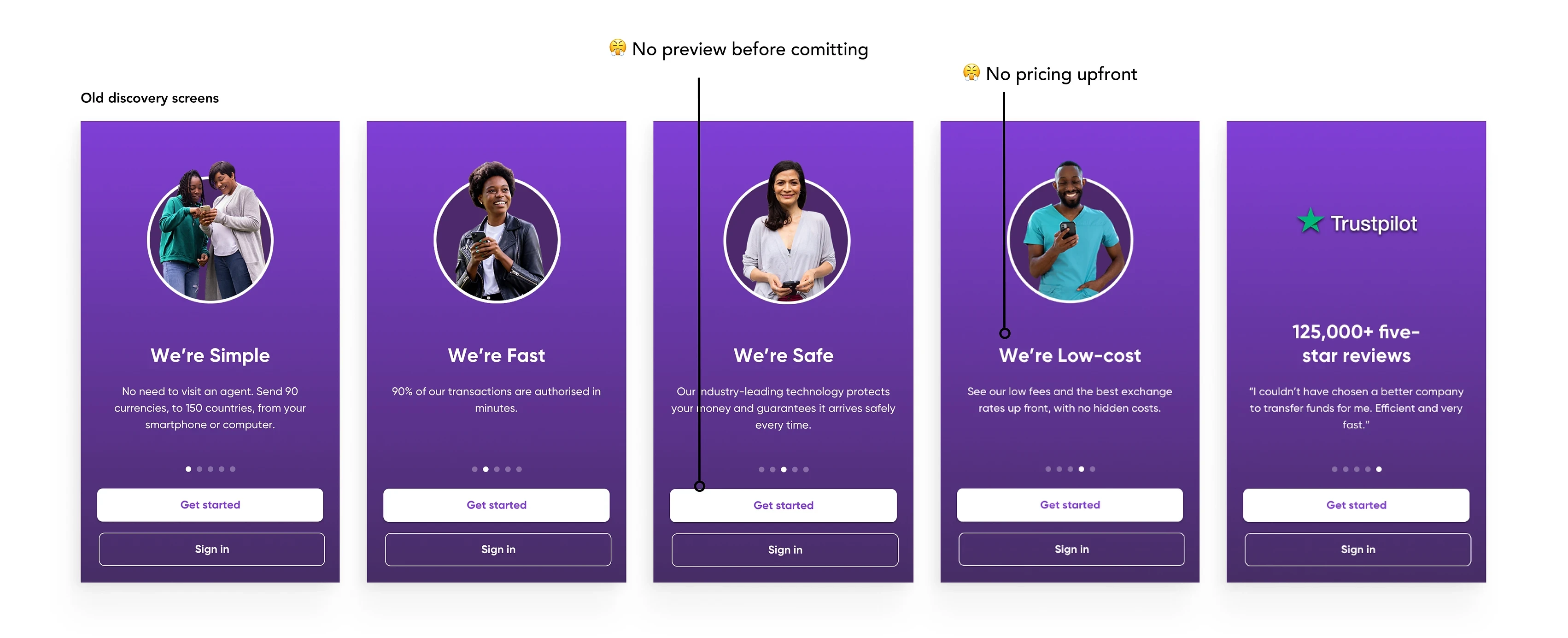
Users found the classic app discovery screens unhelpful in assessing the company's credibility, had low recall, and experienced false memory recognition.
Set correct expectations
for users
Improve onboarding and user conversion rates
Build trust through clear, simplified content
Help users navigate and understand basic features
opportunity.
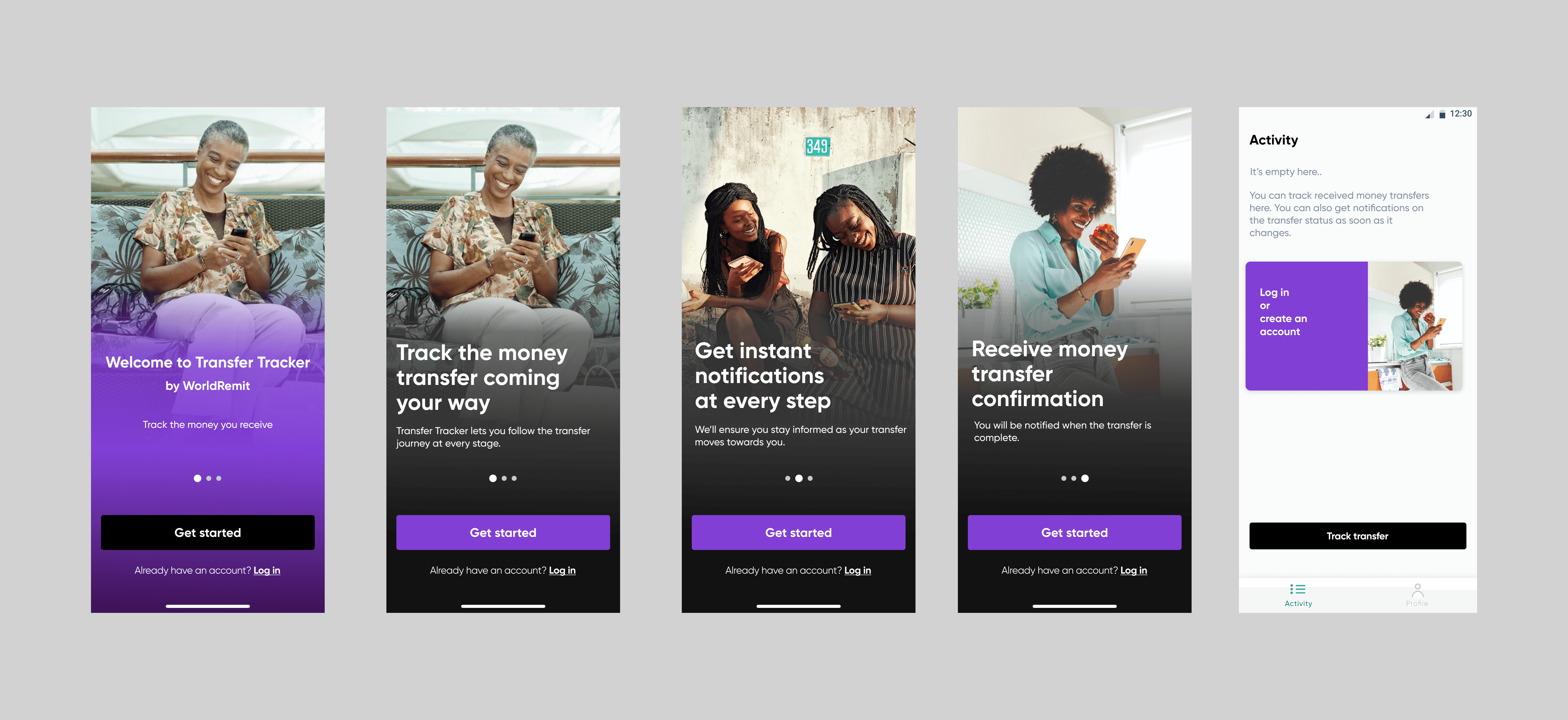
An onboarding carousel is a tool to guide new users through the initial steps of starting a website or app. Designed to provide a seamless and user-friendly experience, it allows users to easily navigate and understand the different features and functions of the product.
process.
For this assignment, I focused on the features that highlights the user benefits. And moved away from "here’s what our product can do" to "here’s what you can do with our product and how it may make you feel".
The team:
2 Product Designers
1 Content Designer
2 Product Managers
1 UX Researcher
Timeline:
Overall: 6+ weeks
Discovery + Research: 2+ weeks
Design + Testing: 4 weeks
first round and results.
We explored direct and indirect fintech competitors, and from there, began drafting various approaches and user flows.
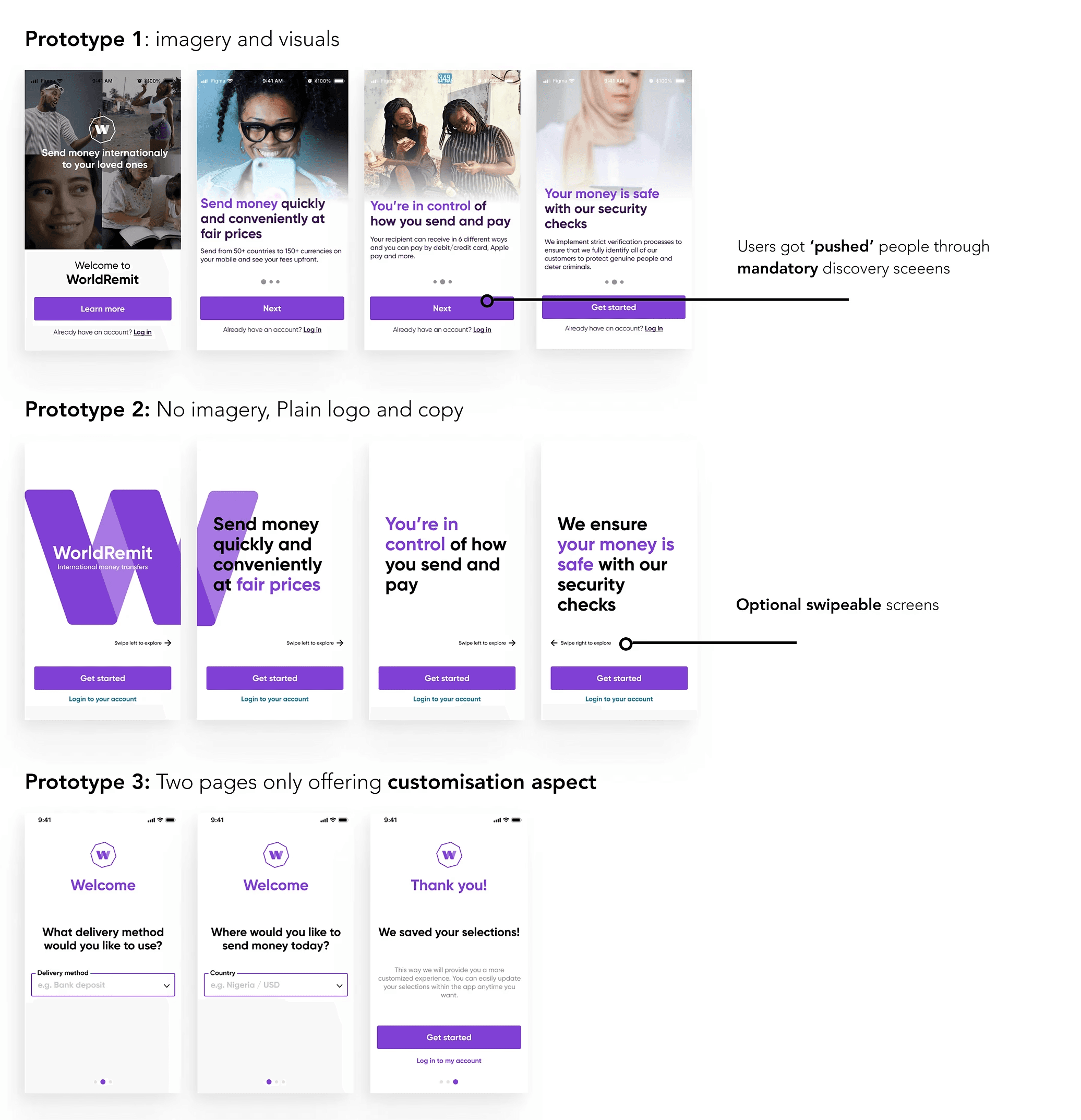
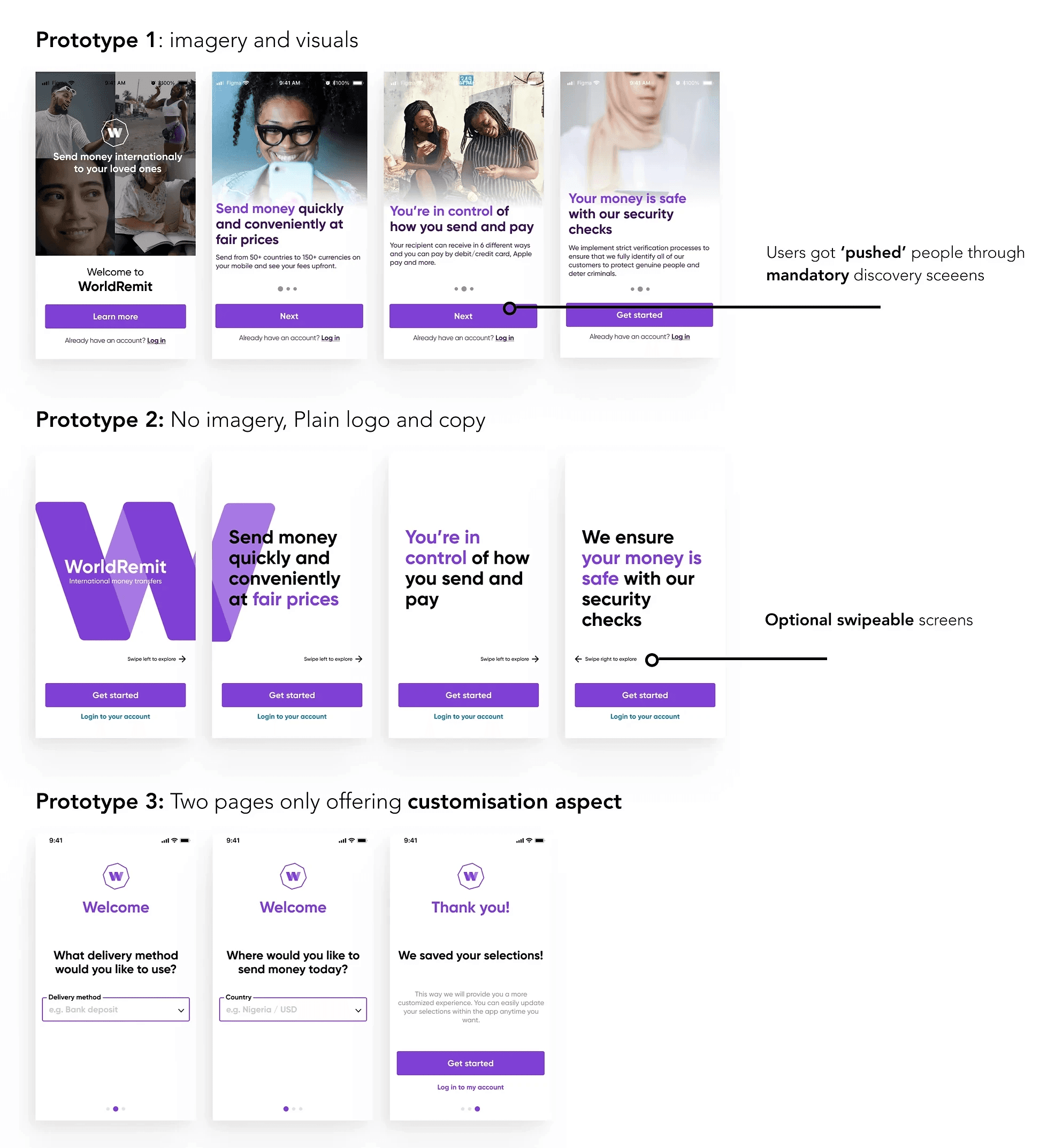
After numerous explorations and obtaining feedback from the design critique sessions, we decided to test 3 prototypes.
Highlights from user testing
We conducted unmoderated tests with remittance users from the US, UK, Germany and Australia.
High engagement on copy and imagery; however, making discovery screens mandatory made some users feel that there are too many steps in the whole onboarding journey, and they would prefer to have the flexibility to skip and start sending money.
Users described Prototypes 2 and 3 as too ‘Corporate' and ‘Cold’.
Prototype 3 was the most preferred option in terms of fewer steps throughout the journey, as well as its customisable nature for users.
Design approach rationale
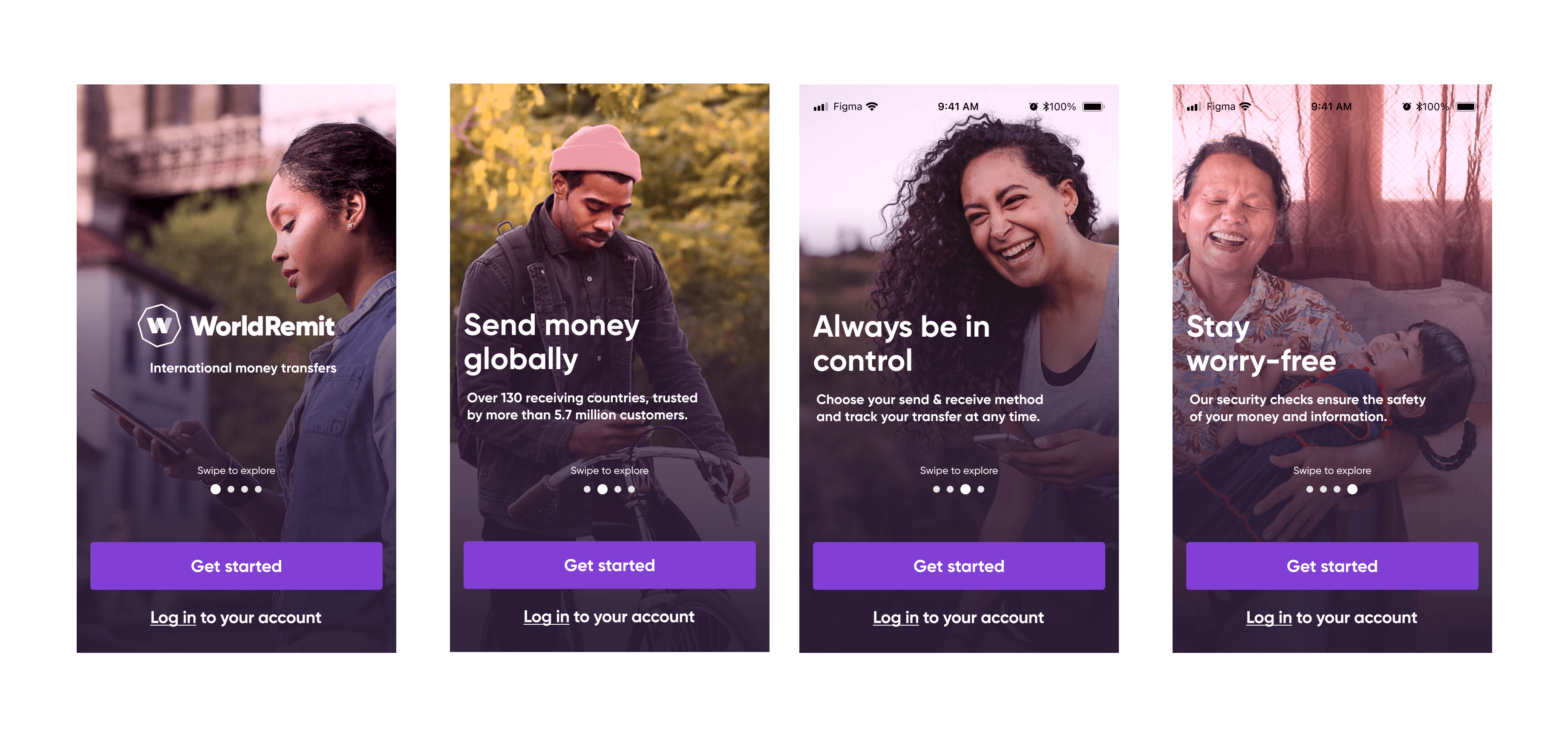
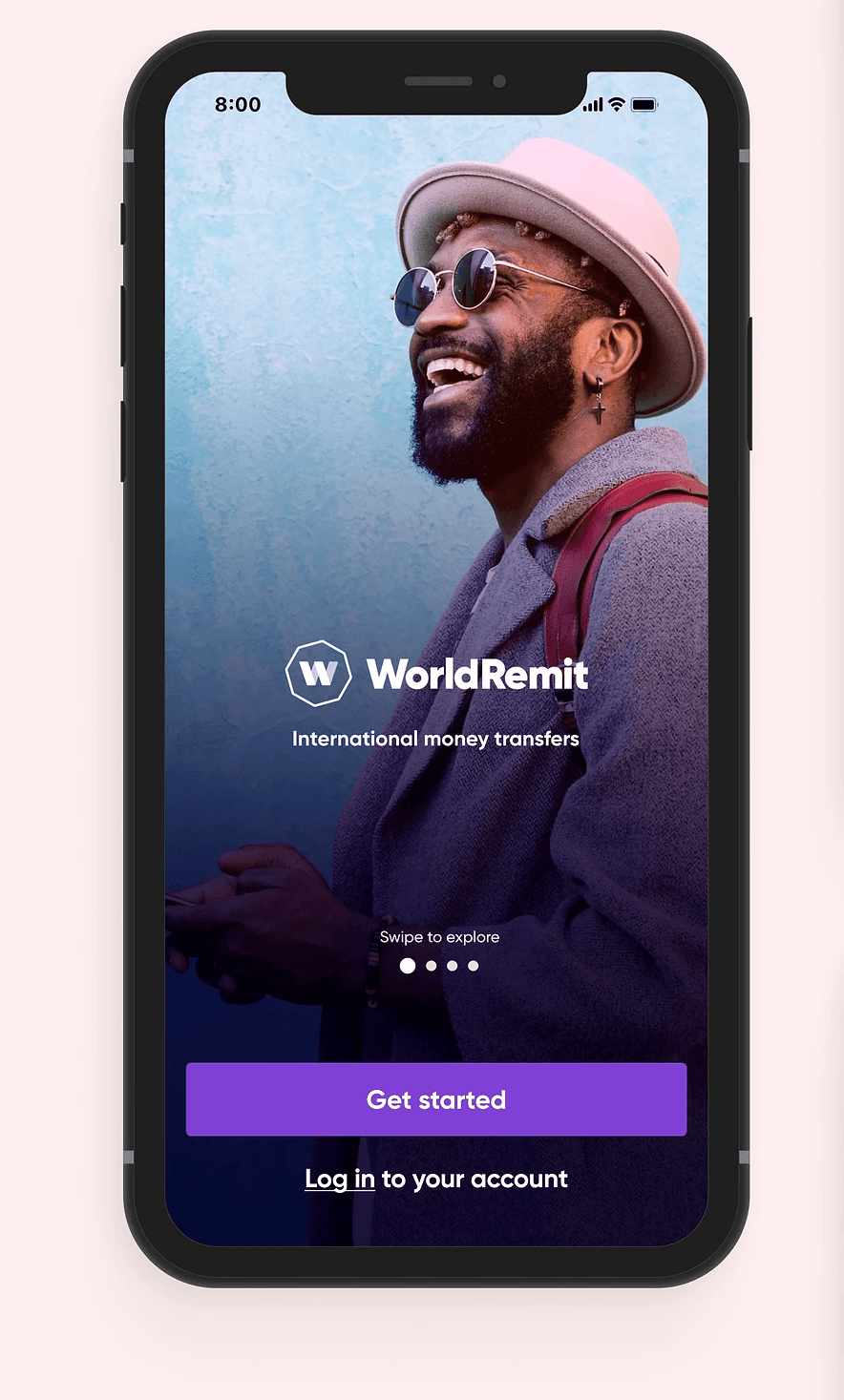
After analysing our findings, we decided to use imagery to achieve the warmth and ‘human aspect’ that resonated well with our users.
We retained the option of swipeable discovery screens. We made a minor enhancement by adding microcopy next to the carousel sign to indicate that there is more to explore, even more clearly.
The copy, with its header, body text, and statistics, had a high recall. We would have liked to involve the customisation aspect in discovery screens, but since we knew this was not in scope for the Pilot, we kept this approach on the back burner.
second round and results.
Our second user testing session took the form of a preference test, in which we aimed to validate how users perceive different variants of copy, page layout, and overall feedback on visuals and imagery.
Variant 2 was the most preferred by 44% of the participants, followed by Variant 3 with 30% and lastly Variant 1 with 26%.
Participants preferred Variant 2 due to their incorrect perception that it had shorter copy and, therefore, it was easier to read. But the copy is the longest of all of them; the font size between the headline and description might be the reason for that positive effect.
In addition to the high recall of the statistics in the descriptions (e.g., "130 receiving countries", "Over 5 millions customers", etc.), the importance of incorporating these trust elements on the discovery screens is a consistent insight when comparing learnings from testing the web relaunch in 2020.
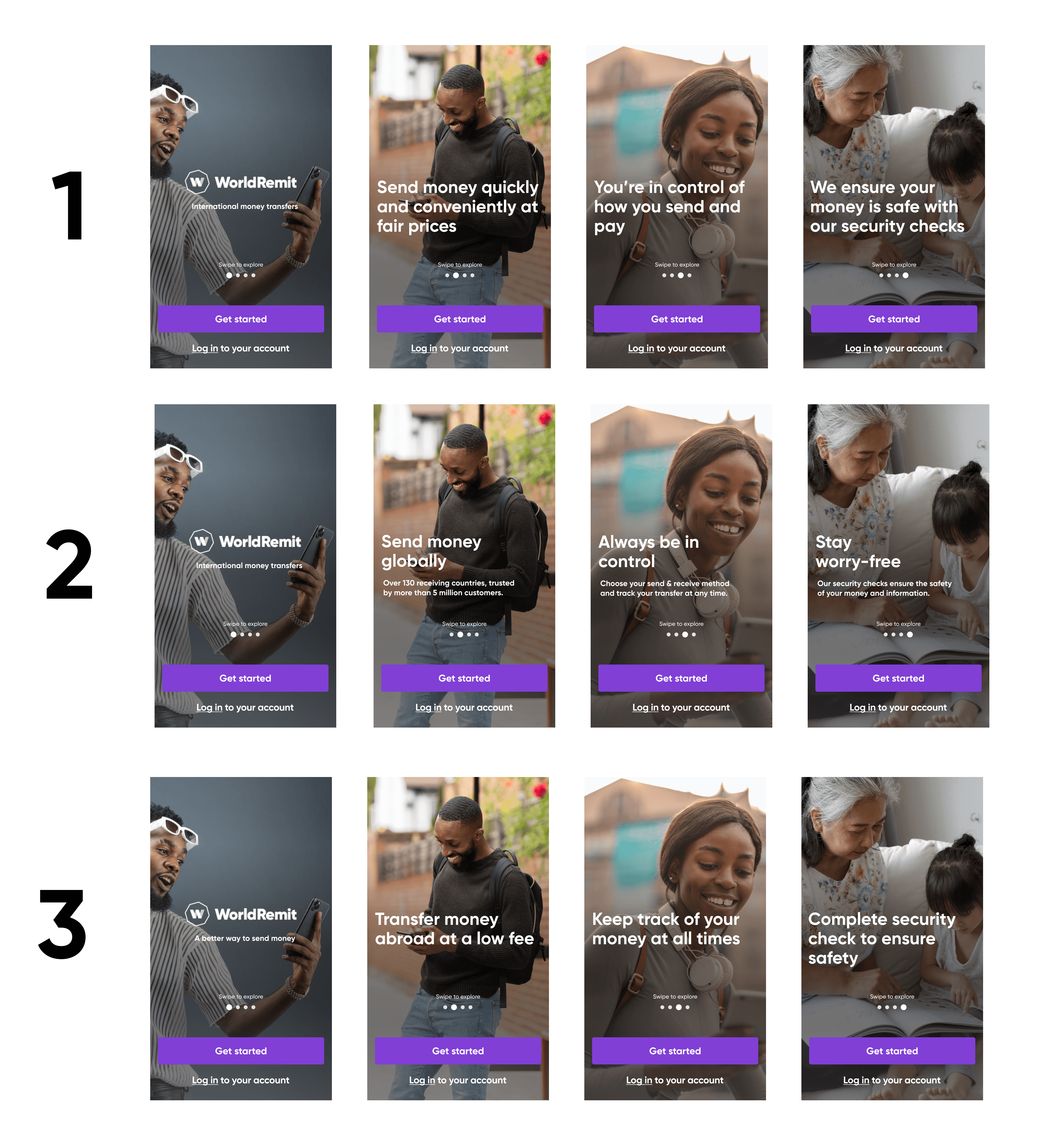
When it came to participants describing the app in their own words after the study, participants who preferred variants 1 & 2 gave descriptions accordingly to a money transfer company, whilst participants who preferred variant 3 described the app as if users could both send & receive (e.g, "It's like PayPal", "Similar to Venmo").
Users preferred the variant with shorter headers. The body copy supported each header to elaborate on the main USP. This approach enables the creation of punchier statements that leave a lasting impression and provide necessary context.
result.
WorldRemit launched the new screens in Poland, Australia, New Zealand, and the UK first, and they were A/B tested against the classic app screens. After a couple of months, we were confident in their performance and rolled out the new onboarding screens globally.